BTS Island: In the SEOM Puzzle
- 4.9
- Rating
- 5.00M
- Installs
- Free
- Price

 Analysis by App-foxy
I approached BTS Island: In the SEOM Puzzle expecting a familiar match-three game with a music-themed coat of paint, but its appeal is more specific than that. It uses short puzzle sessions as the main activity while building a relaxed island setting around BTS, so the reason to keep playing is not only the next board. I found myself switching between the immediate satisfaction of clearing pieces and the longer-term curiosity of seeing what the island would offer next.
That combination makes this a particularly easy game to recommend to BTS fans who want something light rather than a demanding strategy title. It is also approachable for anyone who enjoys colorful puzzle games and does not mind a strong character-focused presentation. The important distinction is that the BTS setting is not a small decoration around a standard puzzle board; it shapes the mood, the motivation, and the way progress feels.
How the first goals pull you into the island
The opening stretch works because it gives the puzzle action a clear purpose. Instead of treating each level as an isolated exercise, the game encourages me to think about the island as an ongoing place. Completing a board feels like a small step toward the next piece of the experience, which is more motivating than simply watching a level counter rise.
You May Also Like

 Blood Strike: 2.5 Anniversary
Blood Strike’s Loadouts Turn Every Drop Into a Tactical Gamble
A close look at Blood Strike’s custom loadouts: how fast access to signature weapons reshapes its battle royale rhythm, rewards preparation, and narrows the gap between fights.

 Pandora - Music & Podcasts
Pandora’s Music Is Easy to Start, but Harder to Recover
Pandora’s strength is its low-effort path from a seed to a station. Its weak spot is how much confidence it asks you to place in connection, setup, and quiet recovery.

 8 Ball Pool
 Is Built on Rivalries, Rematches, and Routine
A close look at the rivalries, rematches, shared routines, and unanswered safety questions that turn a quick pool match into a persistent mobile community.

 Samsung Music
’s Quiet Strength Is Playing What You Already Own
Its reach comes less from spectacle than from dependable access to a personal library. That simplicity is both the app’s strongest retention engine and its ceiling.

 AccuWeather: Weather Radar
AccuWeather Review: A Quick, Clear Forecast for Everyday Decisions
For everyday plans, the best forecast is the one you can understand quickly. AccuWeather makes rain timing, radar, and local conditions easy to act on, with a few trade-offs.

 Hill Climb Racing
Why Hill Climb Racing Still Turns Crashes Into One More Run
A tiny car, a bumpy hill and one more upgrade: Hill Climb Racing keeps resurfacing because its simple chaos makes every near-miss feel personal.
More From Our News Desk
View All News


The early goals are easy to understand without making the game feel empty. I can begin a session, solve a few boards, and stop without needing a long explanation of the rules. That makes it suitable for a commute, a short break, or a few quiet minutes before bed. At the same time, the character presentation gives those brief sessions a little more personality than a purely abstract puzzle game.
I especially like this structure for players who prefer gentle direction. Some match-three games throw a large collection of menus, currencies, events, and upgrade choices at the player immediately. This one feels more inviting because the island provides a visual reason to continue. The goals are not just about beating a board; they suggest that progress will gradually make the setting feel more complete.
There is also a useful emotional difference between playing for a score and playing to move a small story-like world forward. If I am tired, I do not need to approach a level as a serious test. I can treat it as a compact task, enjoy the presentation, and return later. That low-pressure entry point is one of the strongest parts of the design.
Still, the same focus may not suit everyone. A player looking for deep competitive puzzle mechanics, complex planning, or a large amount of control over every move may find the early experience too gentle. The island atmosphere is the main source of charm, so people who are indifferent to BTS or character-driven presentation will get less value from the surrounding progression.
Why the setting matters beyond decoration
The island gives the game a stronger identity than a generic collection of colored tiles. It creates a reason to care about what happens after a successful puzzle, even when the board itself follows a familiar match-three rhythm. In my experience, that context makes repetition easier to accept because each completed level belongs to a larger journey.
This is also where the game differs from the usual alternatives in its category. A conventional match-three title may rely mostly on increasingly difficult boards, while this game asks me to return for the combination of puzzles and BTS-themed island life. A purely story-based mobile game may offer more narrative focus but less instant activity. Here, the puzzle board remains the dependable core, while the island supplies the personal connection.
For new players, my practical advice is to avoid rushing through the first goals simply to reach later content. The opening section teaches the rhythm of the game: play a board, use the result to advance, and notice how the island gradually becomes a reason to return. Taking that rhythm seriously helps reveal whether the game’s slower, more decorative progression is right for you.
Progress signals that make short sessions worthwhile
One of the better choices here is the way progress is felt in several small steps rather than one dramatic reward. A completed puzzle gives immediate feedback, while the broader island direction gives me a reason to play another round. That layered sense of movement is useful when I only have time for a handful of attempts.
I do not need to commit to a long session to feel that I have achieved something. This matters because match-three games can become tiring when every play period feels like a grind toward a distant milestone. In this game, the island theme softens that problem. Even a modest session can feel connected to a larger objective instead of disappearing into an endless list of boards.
The progress signals are also helpful for deciding when to stop. If I have finished a goal and feel my concentration dropping, there is little reason to force another attempt immediately. I can leave and come back later without losing the comfortable, casual nature of the experience. For me, that makes it a better fit for fragmented daily play than games that demand long uninterrupted attention.
A realistic example is an evening when I have ten minutes before doing something else. I can open the game, complete a puzzle or two, and use the resulting progress as a clean stopping point. If a board goes badly, I do not have to turn the session into a serious commitment. I can try again later when I am more patient, which keeps frustration from taking over the whole experience.
There is a trade-off, though. Small progress signals can feel less exciting to players who want major unlocks at a fast pace. The island’s gradual development is part of the appeal, but it also means the game depends on patience. The strongest reason to continue is the steady feeling of building toward something, not constant dramatic surprise.
The free entry point helps with that casual rhythm. The game is free to play, and its content rating is Everyone, so it is easy to consider for a broad audience. Optional purchases range from a small amount to a much larger amount per item, which is worth remembering before spending. I would approach those purchases carefully and decide in advance whether I am comfortable paying to reduce friction or support longer play.
How I would manage the progression
I would treat the island goals as a guide rather than a reason to play every available moment. When a puzzle begins to feel like a chore, taking a break is more sensible than chasing the next reward while annoyed. The game works best when progress remains a pleasant bonus attached to the puzzle, not when the player feels trapped by it.
I also recommend paying attention to why a level was enjoyable or frustrating. If I lose because I made a careless move, I can usually treat that as a concentration problem. If I repeatedly dislike the structure of a board, that tells me more about my tolerance for the game’s challenge curve. This simple distinction prevents me from blaming the whole experience for a temporary mistake.
For BTS fans, the progress system has an additional advantage: the island itself provides a familiar emotional anchor. For non-fans, the question is whether the setting alone is enough to make repeated puzzle sessions feel meaningful. If not, a more traditional puzzle game with fewer character elements may be a better match.
Challenge and the shape of the difficulty curve
The game’s challenge is most effective when it asks for attention without turning every board into a stressful examination. Match-three puzzles are easy to understand, but satisfying play depends on noticing opportunities, planning ahead, and resisting the urge to make the first obvious move. That basic tension gives the short sessions enough substance to avoid feeling completely automatic.
What I appreciate is the way the puzzle activity can remain approachable even when the broader progression gives me a reason to keep improving. I can play casually, but I still have moments where a careless decision costs a promising attempt. Those moments are useful because they add a little tension without changing the game into a hardcore puzzle challenge.
The difficulty curve matters greatly to retention. If every level were effortless, the island goals would eventually feel like a checklist. If the game became punishing too quickly, the relaxed setting would lose some of its value. Its best balance comes when the board asks me to pay attention while the surrounding presentation keeps failure from feeling too severe.
This is where I would set expectations honestly. Players who enjoy difficult logic puzzles may want more depth and sharper escalation than this format provides. The game is designed around accessible match-three play and character-driven progression, not around proving mastery through elaborate systems. It can provide satisfying resistance, but I would not choose it as my main puzzle game if I wanted a demanding daily brain workout.
My most useful tip is to slow down before committing to a move, especially when several possible matches are visible. The obvious match is not always the most useful one for the board’s immediate objective. Even without turning each level into a mathematical exercise, taking a moment to scan the available choices makes the game feel more deliberate and reduces avoidable losses.
Another good habit is to separate a difficult board from the overall value of the game. A frustrating attempt may simply be a temporary obstacle in a larger, otherwise comfortable routine. If I keep replaying while irritated, I stop noticing the island presentation and begin judging everything through that single failed board. A short pause often gives the game a fairer chance.
Who will enjoy the challenge most
This is a good fit for someone who likes puzzles that can be understood quickly but still reward a little planning. It suits players who want a relaxing game with enough resistance to prevent complete autopilot. BTS fans are likely to get the most from the blend of familiar characters, island progression, and compact puzzle sessions.
I would be more cautious recommending it to someone who dislikes repeated attempts, gradual unlocks, or games where the atmosphere is as important as the mechanics. It is also not the obvious choice for a player who wants a competitive leaderboard focus, a pure minimalist puzzle interface, or a story that moves forward without frequent puzzle play.
Retention pressure, spending, and the point where play feels like work
Every progression-based puzzle game has to balance encouragement with pressure. This one keeps me interested through the relationship between the board and the island, but that same relationship can make me feel that I should continue even when I am no longer enjoying the session. The game is at its best when I return because I want the next small step, not because I feel obligated to protect a streak of progress.
The free-to-play structure deserves a practical look. Since the game costs nothing to start, it is easy to test whether the BTS presentation and puzzle rhythm suit me. The presence of in-app purchases means I would avoid treating optional spending as part of the basic price. I would play normally first, then decide whether any purchase genuinely improves my experience rather than buying impulsively after a frustrating board.
The listed purchase range stretches from twenty-nine cents to one hundred ninety-nine dollars and ninety-nine cents per item. That is a wide gap, so I would be particularly careful with confirmation screens and device settings if children might use the same device. The Everyone rating makes the game broadly accessible, but age suitability and spending supervision are separate questions.
This is one of the less obvious trade-offs for families. The game’s friendly presentation may make it look entirely harmless as a shared casual activity, yet any free-to-play title with optional purchases deserves a clear household rule. I would decide whether purchases are allowed before handing the device to a younger player, rather than explaining it after an accidental transaction.
Another retention issue is repetition. The island gives repeated puzzle sessions a purpose, but it cannot remove the basic fact that the central activity remains match-three play. If I play for too long in one sitting, the individual boards begin to blend together. Short sessions protect the game’s charm, while extended grinding makes its limitations more visible.
That is why I would not judge the game by how many hours it can absorb. Its value comes from how comfortably it fits into small gaps in the day. Someone who wants a game to occupy an entire afternoon may eventually find the loop too familiar. Someone who wants a few pleasant rounds with a BTS-centered setting may find the same loop reassuring.
Device expectations and long-term suitability
The game supports devices running Android 7.0 or later, and the current version is 3.5.0. That makes checking the operating system the first practical step before installation. Once it is available on a compatible device, the more important question is not technical novelty but whether the chosen phone or tablet is comfortable for repeated visual puzzle play.
The developer is DRIMAGE Co., Ltd, and the game has built a substantial audience, with more than five million installs and an average rating of 4.9 from roughly five hundred twenty-six thousand ratings. Those figures suggest that the presentation and core loop have connected with many players, but they do not replace personal testing. A strong public response cannot tell me whether I will enjoy the pacing, the BTS focus, or the amount of repetition.
The release date was June 17, 2022, which also helps place the game’s style in context. It is not trying to be a brand-new experiment in mobile puzzles. Its appeal comes from combining a known format with a specific licensed-feeling world centered on BTS. I see that familiarity as a strength for accessibility, but not as a reason to expect radical innovation in the puzzle genre.
My progression verdict after weighing the whole loop
I think BTS Island: In the SEOM Puzzle succeeds when its goals, island setting, and match-three boards support one another. The early objectives make the game easy to enter, the gradual progress signals give short sessions a purpose, and the challenge adds enough attention to keep the puzzles from becoming completely passive. The pacing is most comfortable when I let it remain a casual routine rather than trying to rush through everything.
Its clearest strength is emotional continuity. A board is not only a board; it is part of a BTS-themed island experience. That makes the game more personal than a standard puzzle app for fans, while still leaving a straightforward match-three activity for newcomers. The clearest weakness is that the same loop can feel repetitive or too gentle for players seeking deep puzzle complexity and fast, dramatic progression.
I would recommend it to BTS fans who want a friendly mobile game for short breaks, to casual puzzle players who enjoy character-focused worlds, and to families willing to manage optional spending responsibly. I would skip it in favor of a more demanding puzzle title if my priority were difficult logic, competitive pressure, or a highly technical mastery curve.
After weighing the progression, I see it as a game that earns continued play through atmosphere and steady goals rather than constant mechanical reinvention. That is not a flaw, provided I approach it with the right expectations. For me, the best way to enjoy it is to play in small sessions, treat each island step as a bonus, and stop before the comfortable rhythm turns into a chore.
Released on June 17, 2022, and still presented through its current 3.5.0 version, it remains an appealing choice for the audience it clearly understands. I would recommend starting for free, playing long enough to experience the early progression, and then deciding whether the BTS island atmosphere adds enough value to justify returning. If it does, the game offers a pleasant, accessible puzzle routine; if it does not, the familiar match-three foundation alone may not be enough to carry the experience.
FAQs for BTS Island: In the SEOM Puzzle
01What is BTS Island: In the SEOM Puzzle?
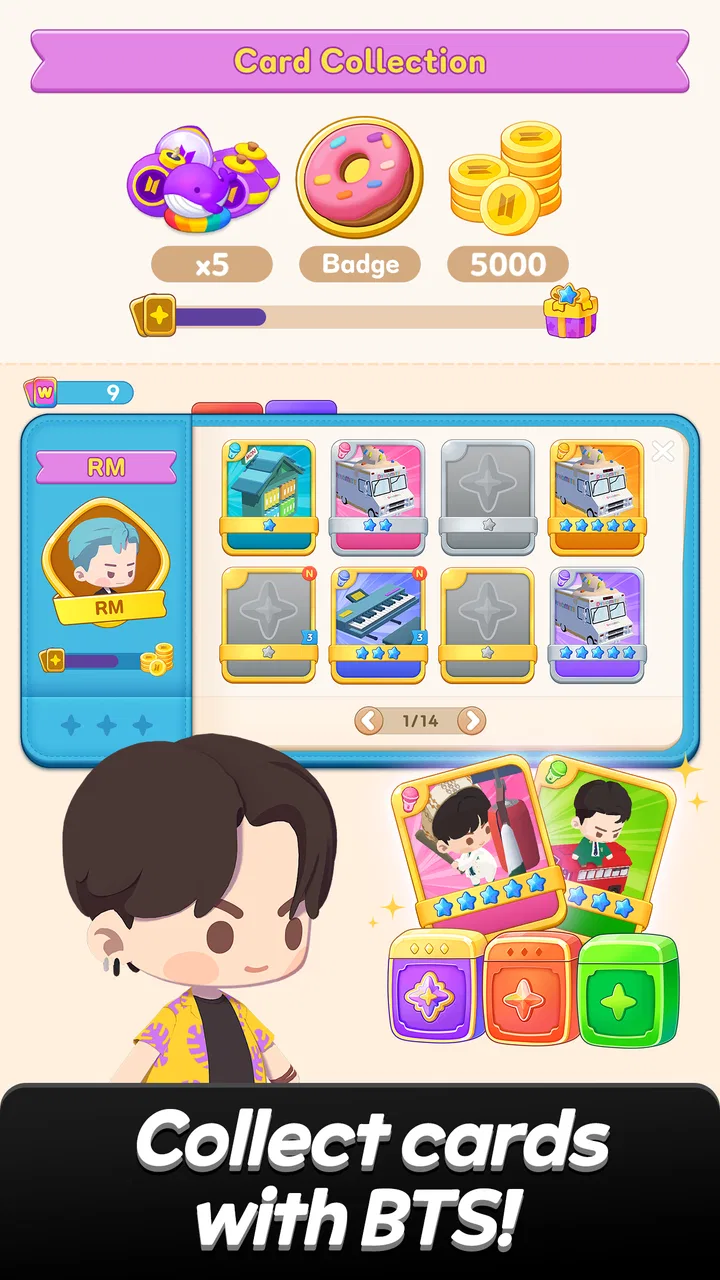
BTS Island: In the SEOM Puzzle is a casual match-3 puzzle game combined with a light island-building adventure. Players complete colorful levels by matching tiles, earn rewards, and use those resources to develop an island inspired by BTS. The game also includes character interactions, story moments, costumes, decorations, and collectible content designed for both puzzle fans and BTS supporters.
02Is BTS Island: In the SEOM Puzzle free to download and play?
Yes, the game can generally be downloaded and played for free on compatible Android and iOS devices. However, it includes optional in-app purchases for items such as extra lives, boosters, currencies, or special bundles. Progress is possible without spending money, although some difficult stages and limited-time events may feel more convenient when using earned or purchased resources.
03Does the game require an internet connection?
An internet connection is recommended and may be required for several important features, including account synchronization, event content, advertisements, in-app purchases, updates, and access to online rewards. Some puzzle sections may work temporarily offline, but the experience is not designed as a fully offline game. Connecting regularly also helps prevent progress or reward synchronization problems.
04Is BTS Island: In the SEOM Puzzle suitable for players who are not BTS fans?
The game is accessible to players who do not follow BTS because its core gameplay is a familiar match-3 puzzle system with simple controls and short levels. Nevertheless, much of the game’s personality comes from the BTS-themed characters, dialogue, music-related references, costumes, and island decorations. Players mainly interested in challenging puzzles may find the progression and story elements fairly casual.
05Are there ads and in-app purchases in BTS Island: In the SEOM Puzzle?
Yes, the game may offer optional in-app purchases and advertisements, depending on the device, region, and current version. Ads can sometimes provide useful rewards, while purchases may include coins, boosters, lives, or promotional packages. Before downloading, parents and players should review the store settings and enable purchase restrictions if the game will be used by children.
Pros
- Relaxing match-3 gameplay is easy to learn and suitable for short sessions.
- BTS-themed story scenes add personality and motivation beyond standard puzzles.
- Each member has distinct dialogue and interactions that fans will appreciate.
- Regular events provide new objectives and help keep the experience fresh.
- The colorful island setting and polished character art look appealing on mobile screens.
Cons
- Energy limits can interrupt play when you want to continue solving puzzles.
- Later stages may require repeated attempts or carefully planned booster use.
- Some rewards and progress systems can feel heavily tied to daily check-ins.
- The large amount of BTS content may not appeal to players unfamiliar with the group.
- Updates and downloadable assets can consume noticeable storage over time.

BTS Island: In the SEOM Puzzle
Gallery